
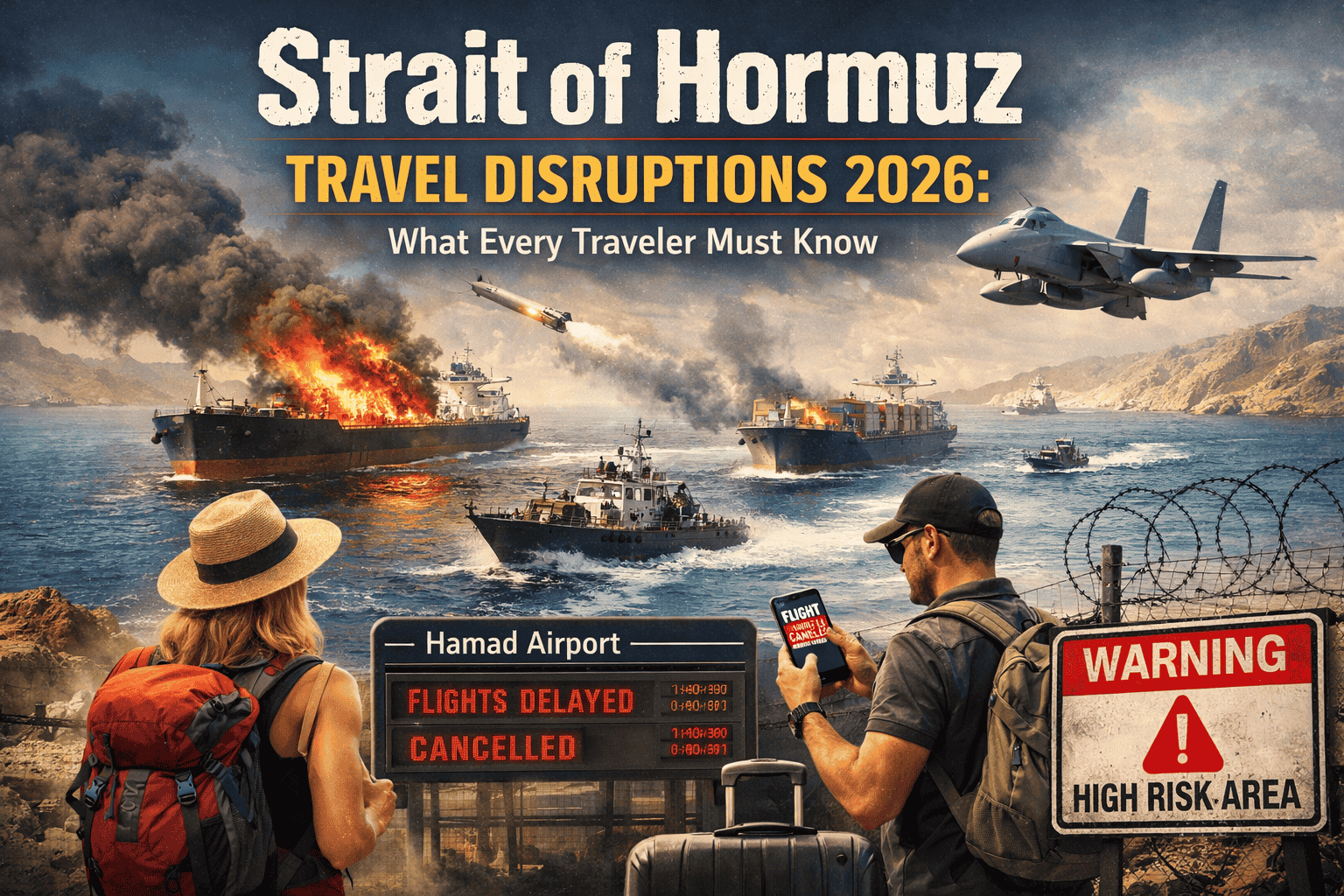
| ⚠ ACTIVE TRAVEL ALERT Multiple governments have issued ‘Depart Now’ advisories for the Middle East. Airlines are cancelling flights and imposing fuel surcharges worldwide. Review your bookings and travel insurance immediately. |
A narrow waterway you may never have planned to visit is now the single biggest threat to your next vacation — wherever in the world you are headed.
Since February 28, 2026, the Strait of Hormuz — a 21-mile-wide passage between Iran and Oman — has been effectively closed to most commercial shipping. What started as a geopolitical conflict has rapidly escalated into the most severe global travel and energy disruption in decades. Flight prices are skyrocketing, routes are being slashed, and jet fuel is running dangerously short at airports across three continents.
If you have any upcoming travel plans — whether to Dubai, London, Bangkok, or New York — this crisis is already affecting you.
| 20% of world’s oil flows through Hormuz | $126 Brent crude peak (per barrel) | $195 Jet fuel per barrel (IATA) | +95% US jet fuel cost surge |
What Is the Strait of Hormuz Crisis?
The Strait of Hormuz is the world’s most critical energy chokepoint, connecting the oil-rich Persian Gulf to global markets. On February 28, 2026, following joint US-Israel military strikes on Iran, Iran’s Islamic Revolutionary Guard Corps effectively closed the strait to most commercial shipping through missile attacks, drone strikes, and direct threats to vessels.
Shipping traffic collapsed almost immediately — from over 100 vessels daily before the conflict to just 21 tankers transiting in the weeks following. Thousands of seafarers are stranded aboard ships unable to pass through the strait. The International Energy Agency has described this as the most significant energy supply shock in the history of the global oil market.
How Is This Affecting Flights and Air Travel?
Fuel is the single largest operating cost for any airline. With jet fuel now averaging $195 per barrel — more than double last year — airlines worldwide are passing costs directly onto passengers or simply cutting unprofitable routes entirely.
Flight Cancellations
- European airports including those in Bologna, Milan, Venice, and Treviso have restricted refueling services due to jet fuel shortages.
- Ryanair CEO Michael O’Leary warned of 5-10% summer flight cancellations if the Strait of Hormuz stays closed.
- Guernsey’s Aurigny airline has already cancelled flights from mid-April through early June 2026.
- Airlines across Asia, Africa, and Europe are reducing flight frequencies on long-haul routes.
Soaring Ticket Prices
Airlines are imposing emergency fuel surcharges and raising base fares across all routes. Long-haul flights to the Middle East, Southeast Asia, and trans-Atlantic destinations are seeing the steepest increases. Budget carriers operating on thin margins are among the hardest hit.
Fuel Tankering
To avoid refueling at fuel-short airports, many airlines are now ‘tankering’ — loading extra fuel at departure airports. While this keeps planes in the air, it adds weight, increases fuel burn, and further drives up operating costs.
Which Destinations Are Most Affected?
- Middle East (UAE, Qatar, Saudi Arabia): Governments have issued ‘Depart Now’ advisories. Embassies are closing. Airport and airspace disruptions are ongoing. Tourism to Dubai, Abu Dhabi, and Oman is severely impacted.
- Europe (UK, Italy, France): Jet fuel shortages at multiple airports. The UK is described as especially vulnerable due to reliance on Kuwaiti fuel. Summer holiday prices could spike significantly.
- Asia (India, Southeast Asia): Immediate fuel supply impact as shipments routed through the Gulf dry up. Long-haul fares from Europe and the Americas to Asia are surging.
- Africa: African carriers — already operating on thin margins — face severe connectivity disruptions due to imported fuel dependency.
Is It Safe to Travel to the Middle East Right Now?
Multiple governments — including the US, UK, France, and Germany — have issued urgent travel warnings for the region. The situation is classified as a ‘Critical — Active Multi-Front Armed Conflict’ with active missile and drone strikes impacting civilian infrastructure across multiple countries.
| ⚠ OFFICIAL TRAVEL ADVISORY SUMMARY AVOID ALL TRAVEL: Iran, Yemen, parts of Iraq, Lebanon, areas near Gulf military installations. RECONSIDER TRAVEL: UAE, Qatar, Saudi Arabia, Kuwait, Bahrain — airspace operations are unstable. CHECK YOUR AIRLINE: Routes are being cancelled with little notice. REVIEW TRAVEL INSURANCE: Standard policies may not cover war-zone disruptions. REGISTER WITH YOUR EMBASSY: If currently in the region, contact your embassy immediately. |
What Should Travelers Do Right Now?
- Check for flight changes immediately: Log into your airline app or website. Sign up for flight status alerts.
- Book flexible fares only: Choose fully refundable or change-free tickets for any new bookings. The situation remains unpredictable for the rest of 2026.
- Get comprehensive travel insurance: Ensure your policy covers trip cancellation due to civil unrest, fuel crises, and airline disruptions.
- Avoid non-essential Middle East travel: Until official advisories are lifted, avoid leisure travel to conflict-adjacent areas.
- Budget for higher costs: Expect airfare and accommodation to cost 20-40% more on many routes due to fuel surcharges.
- Monitor news daily: This situation is evolving rapidly. Bookmark your government’s official travel advisory page.
When Will Things Return to Normal?
Shipping analysts assess that routine Hormuz transit is unlikely to resume for the remainder of 2026. Diplomatic efforts are underway — French and South Korean presidents agreed on April 5 to work toward reopening the strait — but no definitive timeline has been established.
For travelers, this means planning for continued volatility in airfare and route availability throughout summer and potentially into autumn 2026. If the disruption extends into mid-2026, industry analysts warn of a prolonged period of high fares, reduced connectivity, and volatile demand across the global travel sector.
SafarTrip’s Bottom Line
The Strait of Hormuz travel disruptions of 2026 represent the most significant threat to global travel since the COVID-19 pandemic. Whether you are booking a summer holiday or managing an existing itinerary, staying informed and traveling flexibly is essential.
SafarTrip will continue to update readers with the latest travel advisories, flight status information, and destination-specific guidance as this situation develops. Stay safe, travel smart.