
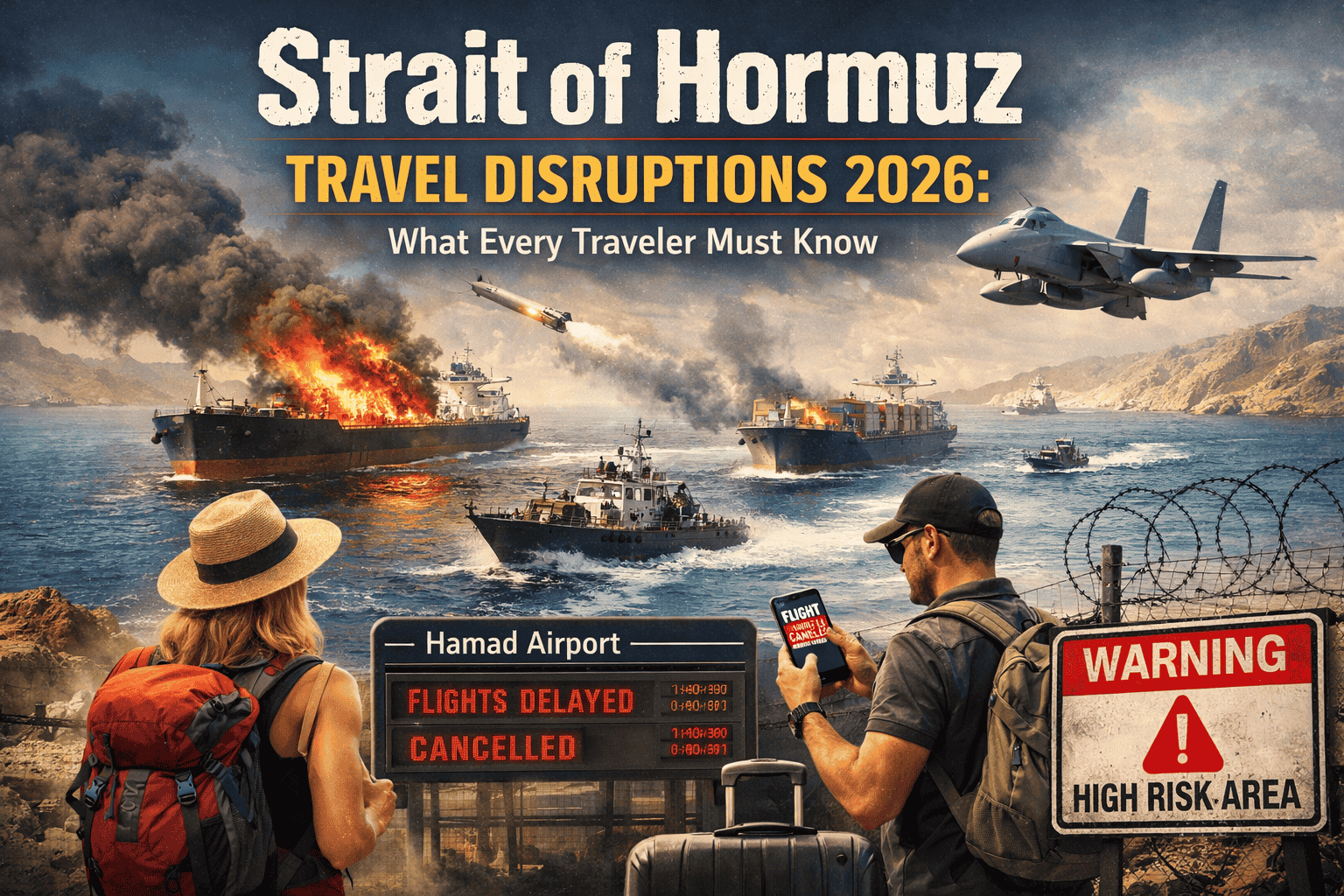

Strait of Hormuz travel disruptions in 2026 refer to flight reroutes, airspace closures, cruise cancellations, and rising fares caused by the ongoing conflict between the United States, Israel, and Iran, which began in February 2026. Airlines are avoiding Iranian, Iraqi, and parts of Gulf airspace, adding hours to Asia-Europe routes, while several cruise lines have dropped Gulf port calls entirely.
Note to site owner: This is an active, fast-changing conflict. Specific advisory dates, airline names, and route details below should be re-verified against official sources (EASA, your national aviation authority, airline advisories) immediately before publishing and periodically afterward.
What Is Causing the Strait of Hormuz Travel Disruptions?
The disruptions stem from a military conflict between the United States, Israel, and Iran that began in February 2026, centered on the Strait of Hormuz — the narrow waterway between Iran and Oman that connects the Persian Gulf to open ocean. Iran has repeatedly declared the strait closed or restricted, while the United States has disputed those claims. This back-and-forth has continued for months, with periods of relative calm interrupted by renewed strikes.
Because the strait sits directly beneath major flight corridors linking Asia, the Gulf, and Europe, aviation regulators have repeatedly told airlines to avoid the airspace over Iran, Iraq, and neighboring Gulf states. Maritime shipping through the strait has also dropped sharply at various points, disrupting fuel and cargo movement that indirectly affects travel costs. The situation has shifted several times between escalation and partial ceasefire, so any snapshot of “current status” needs a checked date attached to it.
How Are Flights Being Affected?
Airlines are rerouting long-haul flights around Iranian, Iraqi, and at times broader Gulf airspace, which typically adds two to four hours to journeys between Asia and Europe. Some carriers have suspended routes into and out of the Gulf region entirely during peak escalation periods, while others continue operating with longer, costlier flight paths.
This is a frequently seen pattern during the conflict: aviation safety agencies issue time-limited advisories (often lasting several weeks), airlines adjust routes accordingly, and the advisories get renewed or lifted depending on how the conflict develops. Rerouted flights over Saudi Arabia, Egypt, or Central Asian corridors have kept most Gulf hub connectivity intact, though at higher operating cost, some of which gets passed on to passengers through fares or fuel surcharges. Delays, last-minute cancellations, and gate changes have also been reported around specific flare-ups in hostilities.
Travelers with layovers in Dubai, Doha, or Abu Dhabi should expect the highest chance of disruption, since these hubs sit closest to the conflict zone. Direct flights to Tehran have been suspended by multiple international carriers for extended periods.
Is It Safe to Travel to the Gulf Region Right Now?
Safety varies significantly by country and changes with the conflict’s intensity, so blanket statements about the entire Gulf region are not reliable. Iran itself is under active conflict conditions and should be treated as unsafe for travel by non-essential visitors. Neighboring countries such as the UAE, Qatar, Oman, Bahrain, and Kuwait have experienced intermittent missile and drone activity, airspace closures, and localized incidents, even though normal daily life mostly continues in major cities during calmer periods.
This is a documented pattern rather than a one-off: Gulf states near the strait have had brief windows of missile or drone activity intercepted by air defense systems, sometimes with reported injuries from falling debris. Given how quickly conditions shift, travelers should check their home country’s official travel advisory for each specific country on their itinerary, not just for the region as a whole, and should do so within days of departure rather than relying on older guidance.
How Are Cruises and Gulf Port Calls Affected?
Several cruise lines have removed Persian Gulf port calls from their itineraries or replaced them with alternative stops outside the conflict zone. This is a common scenario during periods of heightened tension: cruise operators tend to adjust itineraries proactively, sometimes weeks in advance, rather than waiting for a specific incident near their ship’s route.
Affected itineraries have typically substituted Gulf ports with stops in destinations further from the strait, such as ports along the Arabian Sea or Red Sea coast, where conditions allow. Passengers with bookings that include Gulf stops should confirm directly with their cruise line whether the itinerary has changed, since adjustments have occurred with limited advance notice during active escalation periods.
What Should Travelers Do Before Booking or Flying Through the Region?
Travelers should verify flight routing, government travel advisories, and travel insurance coverage before booking or departing, since conditions around the Strait of Hormuz have changed multiple times within days during this conflict.
| Step | Action | Why It Matters |
|---|---|---|
| 1 | Check your government’s travel advisory for each country on your itinerary | Advisories are country-specific, not regional |
| 2 | Confirm your flight’s routing with the airline directly | Rerouted flights can add hours or require a technical stop |
| 3 | Review travel insurance for war-risk or airspace-closure coverage | Standard policies often exclude conflict-related disruptions |
| 4 | Sign up for airline delay/cancellation alerts | Advisories and route changes can occur with little notice |
| 5 | Have a backup routing or refundable fare where possible | Reduces cost if your route is suspended close to departure |
How Long Will the Disruptions Last?
There is no fixed end date, since the disruptions are tied directly to how the underlying conflict develops rather than to a scheduled event. Periods of ceasefire or de-escalation have historically been followed by renewed hostilities within weeks, so any estimate of when normal routing and shipping will resume should be treated as provisional.
Economic analysts monitoring the situation have suggested that the broader effects on trade, fuel prices, and travel costs may take time to fully surface even after active fighting subsides, since supply chains and shipping schedules take time to normalize. Travelers planning trips more than a few weeks out should build flexibility into bookings rather than assuming current conditions will hold.
Frequently Asked Questions
Is the Strait of Hormuz open or closed right now? Status has changed repeatedly between open, partially open, and closed since February 2026, with the US and Iran often giving conflicting statements. Check a live shipping or aviation advisory source close to your travel date rather than relying on older reports.
Will my flight through Dubai or Doha be cancelled? Not necessarily, but delays and rerouting are common during active escalation periods. Contact your airline directly for the latest status on your specific route.
Are flight prices higher because of the conflict? Rerouting adds fuel and operating costs for airlines, which can factor into fares on affected routes, though pricing also depends on demand and season. There’s no fixed markup that applies across all bookings.
Does travel insurance cover cancellations from this conflict? This depends entirely on your specific policy. Many standard travel insurance plans exclude war-related disruptions, so check for a war-risk or “civil unrest” clause before assuming coverage applies.
Which countries are safest to visit in the Gulf region during this conflict? Safety varies by country and by week, so there is no single reliable answer. Consult official government travel advisories for each individual country on your itinerary rather than treating the Gulf as one uniform risk zone.
Should I cancel an upcoming trip to the Middle East? This depends on your specific destination, dates, and the current advisory level for that country, which can change quickly. Review your government’s latest advisory and your airline’s current routing before making a decision.
Summary
The Strait of Hormuz conflict, ongoing since February 2026, has led to flight rerouting, airspace advisories, cruise itinerary changes, and periods of reduced shipping through the waterway. Effects vary significantly by country and by week, with no confirmed end date. Travelers should verify current advisories, flight routing, and insurance coverage close to their departure date rather than relying on static information.