
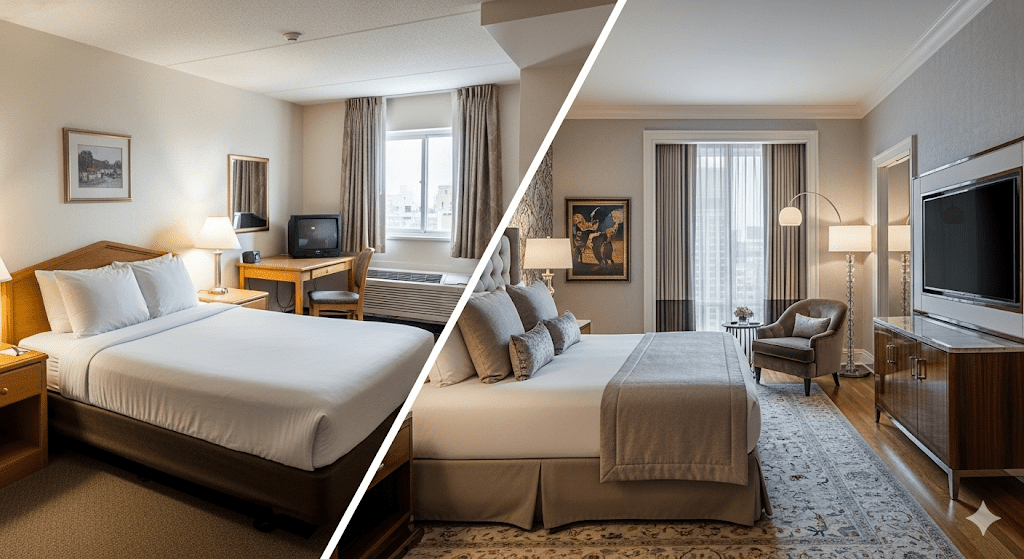

Choosing a hotel is not always as simple as comparing the room price.
A 3-star hotel may offer everything you need for a sightseeing trip, while a 5-star property can make sense when the hotel itself is an important part of the vacation. The difference is usually not just about how luxurious the room looks. It can involve the level of facilities, dining options, guest services, room features, property size, and the overall experience offered by the hotel.
At the same time, a higher star rating does not automatically mean that a hotel is the best choice for every traveler. A well-located 3-star hotel with excellent recent reviews may provide better value for a city sightseeing trip than an expensive 5-star property far from the places you want to visit.
This guide explains the practical differences between 3-star and 5-star hotels in India, what you can generally expect from each category, how pricing works, and how to decide which one is appropriate for your trip.
What Does a Hotel Star Rating Actually Mean?
Hotel star ratings are intended to provide travelers with an indication of the level of facilities, services, and overall accommodation standards they may expect from a property.
However, there is an important point that many travelers overlook:
A star rating is not the same thing as a customer-review score.
A hotel’s star category and its guest reviews answer different questions.
The star category is related to the facilities and service category of the property, while guest reviews can tell you more about the actual experience reported by recent visitors, such as cleanliness, staff behavior, noise, maintenance, food quality, and location.
Hotel classification systems can also vary between countries and organizations. Therefore, travelers should avoid assuming that a particular star category represents exactly the same experience everywhere in the world.
For an Indian hotel, it is useful to check the property’s stated classification along with recent guest feedback before making a booking.
3-Star vs 5-Star Hotels: Quick Comparison
| Feature | 3-Star Hotel | 5-Star Hotel |
|---|
| Main focus | Comfort and practical value | Luxury, service and facilities |
| Rooms | Comfortable and functional | More spacious and premium in many properties |
| Furniture | Practical | Higher-end finishes and furnishings |
| Bathroom | Basic to comfortable | More elaborate fixtures and amenities |
| Dining | Usually limited compared with luxury properties | Multiple dining options are common |
| Room service | Availability varies | Generally more extensive |
| Concierge | May be limited or unavailable | Dedicated concierge is common |
| Gym | May be available | Usually more comprehensive |
| Pool | Property dependent | Common at many full-service properties |
| Spa | Less common | Common at luxury and resort properties |
| Business facilities | Basic to moderate | More extensive |
| Housekeeping | Generally daily | Often more frequent or detailed |
| Price | Lower | Significantly higher |
| Best suited for | Practical stays and sightseeing | Luxury, business and special occasions |
These are general differences rather than guarantees. Individual hotels can offer more or fewer facilities than the typical pattern shown above.
What to Expect from a 3-Star Hotel
A 3-star hotel is generally designed around comfortable accommodation and practical services without the extensive luxury facilities associated with higher-end properties.
For many travelers, that is exactly what they need.
If you plan to spend most of your day sightseeing, visiting attractions, attending meetings, or exploring a city, paying for facilities you will rarely use may not provide much additional value.
Rooms
A typical 3-star property may provide:
- Comfortable bed
- Wardrobe or storage
- Work desk or small table
- Seating area
- Television
- Air conditioning or other climate-control facilities, depending on location
- Private bathroom
- Towels and basic toiletries
- Wi-Fi
- Drinking water
The exact room size and amenities vary considerably from one hotel to another.
This is why checking the actual room description before booking is more useful than assuming every 3-star hotel has identical facilities.
Housekeeping
Daily housekeeping is common in full-service hotels, although the exact schedule and services can vary.
Travelers should check whether:
- Towels are replaced on request
- Extra cleaning is available
- Laundry is offered
- Housekeeping operates at specific hours
Reception and Guest Services
Many 3-star hotels offer reception and basic guest assistance.
Depending on the property, services may include:
- Check-in and check-out assistance
- Luggage storage
- Local information
- Taxi assistance
- Wake-up calls
- Laundry arrangements
- Basic travel assistance
The level of personalized service is usually more limited than at a luxury hotel.
What to Expect from a 5-Star Hotel
A 5-star hotel generally places greater emphasis on service, comfort, facilities, dining, and the overall guest experience.
The biggest difference may not be one individual item inside the room. Instead, it is often the combination of many services and facilities available throughout the property.
Rooms
Luxury properties commonly provide features such as:
- Higher-quality beds and bedding
- Larger or more thoughtfully designed rooms
- More seating
- Better workspaces
- Premium bathroom fixtures
- More extensive toiletries
- Bathrobes and slippers at many properties
- In-room safes
- Minibars or beverage facilities
- Better-equipped entertainment systems
- High-speed internet
However, these features vary by hotel and room category.
A standard room in a 5-star hotel can also be very different from a suite.
Housekeeping and Service
Luxury hotels generally place more emphasis on personalized service.
Depending on the property, guests may have access to:
- 24-hour reception
- Concierge assistance
- Luggage services
- Room service
- Laundry and dry cleaning
- Special occasion arrangements
- Restaurant reservations
- Transportation assistance
Some luxury properties may also provide evening turndown service, although travelers should check the hotel’s current service information rather than assuming it is included.
Room and Bathroom Differences
The room is one of the easiest areas in which travelers notice differences.
3-Star Hotel
The room usually focuses on practicality.
You can expect enough space for sleeping, storing luggage, getting ready, and possibly working.
The furniture may be simple but functional.
Bathrooms generally provide the essentials:
- Shower
- Toilet
- Sink
- Towels
- Basic toiletries
- Hot and cold water where available
5-Star Hotel
A luxury room is usually designed to make the accommodation itself part of the experience.
Depending on the property, you may find:
- Larger sleeping areas
- Premium mattresses
- More seating
- Better lighting
- Larger bathrooms
- Separate shower and bathtub in some rooms
- Premium toiletries
- Bathrobes and slippers
- More extensive storage
- Better in-room technology
But remember that 5-star does not mean every room automatically includes every luxury feature.
Room category matters.
A standard room, executive room, club room, suite, and villa can have very different facilities even within the same hotel.
Services and Staff
Service is one of the areas where the difference between hotel categories can become particularly noticeable.
Services Commonly Found in 3-Star Hotels
Depending on the property:
- Front desk assistance
- Housekeeping
- Basic room service
- Laundry service
- Luggage storage
- Local travel assistance
- Restaurant service
The focus is generally on providing the services necessary for a comfortable stay.
Services Commonly Found in 5-Star Hotels
Luxury properties often provide a wider range of guest services, such as:
- Dedicated concierge
- Porter or luggage assistance
- Extensive room service
- Restaurant reservations
- Event arrangements
- Airport transportation options
- Laundry and dry cleaning
- Special occasion planning
- Business support
- Personalized guest assistance
The important difference is often service depth and availability, rather than simply the number of employees.
Food and Dining
Food can also be a major difference between the two categories.
3-Star Hotels
A 3-star property may have one main restaurant or dining area.
Depending on the hotel, guests may find:
- Breakfast
- Lunch and dinner
- Local cuisine
- A limited room-service menu
- Tea and coffee facilities
Some properties may not offer extensive dining options, so travelers with specific dietary preferences should check the hotel’s restaurant information before booking.
5-Star Hotels
Luxury hotels often provide more choices.
A larger property may include:
- All-day dining
- Specialty restaurants
- Cafés
- Lounges
- Bars
- Extensive breakfast options
- In-room dining
- Private dining arrangements
Resorts may also offer additional dining experiences.
However, more restaurants do not necessarily mean better food for every traveler. Recent guest reviews can be useful when food quality is an important part of your decision.
Amenities and Facilities
Amenities can make a major difference when the hotel is more than just a place to sleep.
| Facility | 3-Star | 5-Star |
| Wi-Fi | Common | Common |
| Restaurant | Common | Common |
| Gym | Property dependent | Common in full-service properties |
| Swimming pool | Property dependent | Common in many luxury properties |
| Spa | Less common | Common |
| Business facilities | Basic to moderate | More extensive |
| Meeting rooms | May be available | Common in business-oriented properties |
| Concierge | Limited or unavailable | Common |
| Valet parking | Property dependent | More commonly available |
| Kids’ facilities | Property dependent | More common at family-oriented resorts |
These are general patterns, not universal rules.
Always check the individual hotel’s current facilities before booking.
Price Difference Between 3-Star and 5-Star Hotels
Price is often the most obvious difference.
But there is no fixed price for either category.
Hotel rates depend on:
- City
- Location
- Season
- Weekend or weekday
- Room category
- Demand
- Events in the city
- Booking date
- Meal plan
- Hotel brand
- Included facilities
For example, a 3-star hotel in a prime city-center location can sometimes cost more than a 5-star hotel located farther from the main tourist area during a promotional period.
That is why travelers should compare the total value of the stay, not only the star rating.
Indicative Price Range in India
As a broad planning guide, travelers may encounter ranges such as:
| Category | Approximate Nightly Range |
| 3-Star | ₹1,500–₹6,000+ |
| 4-Star | ₹3,500–₹12,000+ |
| 5-Star | ₹8,000–₹30,000+ |
These figures are only indicative. Rates can be substantially higher in luxury resorts, major tourist destinations, premium room categories, and peak travel periods.
When Should You Choose a 3-Star Hotel?
A 3-star hotel can be the smarter choice when accommodation is not the main purpose of your trip.
1. City Sightseeing
If you plan to leave the hotel early and return only after visiting attractions, a comfortable 3-star hotel may provide everything you need.
2. Short Business Trips
If you primarily need:
- A clean room
- Reliable internet
- A comfortable bed
- Convenient location
- Basic breakfast
then a 3-star property may be sufficient.
3. Road Trips
For a one-night stopover, spending a large amount on luxury facilities may not make financial sense.
4. Longer Trips
When staying for several nights, choosing a reasonably priced hotel can leave more of your travel budget for activities, food, transportation, and sightseeing.
5. Budget-Conscious Travel
If you would rather spend money on experiences than accommodation, a good 3-star hotel can offer strong value.
When Is a 5-Star Hotel Worth the Extra Money?
A 5-star hotel becomes more attractive when the hotel itself is part of the experience.
1. Honeymoons and Special Occasions
For anniversaries, honeymoons, birthdays, or other important celebrations, additional comfort and service may be worth paying for.
2. Resort Holidays
If you expect to spend most of your vacation inside the property, facilities such as pools, restaurants, spas, gardens, and recreational areas become much more valuable.
3. Business and Corporate Travel
For certain business trips, guests may value:
- Meeting facilities
- Business services
- Convenient dining
- Quiet workspaces
- Concierge assistance
- Central locations
Whether a 5-star hotel is necessary depends on the company’s budget and the purpose of the trip.
4. Families Looking for On-Site Facilities
A family-oriented luxury resort may provide pools, children’s activities, multiple dining options, and larger recreational areas.
But parents should compare the actual facilities of each property instead of assuming every 5-star hotel offers the same family services.
5. When Convenience Matters
If you want to have restaurants, fitness facilities, spa services, business facilities, and other services available without leaving the property, a full-service luxury hotel can provide significant convenience.
Is a 4-Star Hotel a Better Middle Ground?
For many travelers, yes.
A 4-star property can offer a useful balance between price and comfort.
Depending on the hotel, you may get:
- More spacious rooms
- Better furnishings
- Swimming pool
- Gym
- Better dining options
- More extensive guest services
- More comfortable common areas
The exact facilities still vary by property.
If a 5-star hotel is significantly beyond your budget but a basic 3-star property feels too limited, comparing well-reviewed 4-star hotels can be worthwhile.
Star Rating vs Guest Reviews: Which Matters More?
This is one of the most important points in hotel selection.
Imagine two hotels:
Hotel A: 5-star, but recent guests repeatedly complain about cleanliness and maintenance.
Hotel B: 3-star, with consistently strong recent reviews mentioning clean rooms, helpful staff, and a convenient location.
For a sightseeing trip, Hotel B may actually provide the better experience.
Star rating tells you about the category and facilities.
Reviews can tell you about the actual guest experience.
Before booking, look for patterns in recent reviews rather than focusing on one extremely positive or negative comment.
Pay particular attention to:
- Cleanliness
- Bathroom condition
- Staff behavior
- Noise
- Location
- Wi-Fi
- Food
- Maintenance
- Value for money
Recent reviews are generally more useful than very old reviews because hotel management and property conditions can change.
How to Choose a Hotel Without Overspending
Compare the Location First
A cheaper hotel 10 miles away from your main attractions may cost more once daily transportation is included.
For sightseeing, a convenient location can sometimes be worth paying slightly more for.
Check What the Room Rate Includes
Two hotels with similar room prices may offer very different packages.
Check whether the rate includes:
- Breakfast
- Wi-Fi
- Parking
- Taxes
- Airport transfer
- Extra guest charges
Compare the Total Cost
Do not compare only the advertised room rate.
Calculate the expected total cost of the stay.
A hotel with a slightly higher room rate may actually be cheaper if it includes breakfast and parking.
Read Recent Reviews
Look for repeated patterns rather than isolated comments.
If many recent guests mention the same problem, take it seriously.
Check the Cancellation Policy
Travel plans can change.
A flexible cancellation policy may be worth paying slightly more for, particularly when booking far in advance.
Common Mistakes Travelers Make
Mistake 1: Choosing Only by Star Rating
A higher rating does not automatically mean the hotel is right for your trip.
Mistake 2: Ignoring Location
A luxurious hotel far from everything you want to see can make a sightseeing holiday inconvenient.
Mistake 3: Looking Only at the Cheapest Rate
Taxes, breakfast, parking, transportation, and other charges can change the final cost.
Mistake 4: Reading Only the Overall Review Score
Read the actual recent comments to understand what guests like and dislike.
Mistake 5: Assuming Every Hotel in a Category Is Identical
Two 5-star hotels can provide very different experiences.
The same is true for 3-star hotels.
Mistake 6: Paying for Facilities You Will Never Use
If you spend twelve hours every day outside the hotel, an expensive spa, pool, or multiple restaurants may not provide much value.
Frequently Asked Questions
Is a 5-star hotel always better than a 3-star hotel?
Not necessarily.
A 5-star hotel generally offers more extensive facilities and a higher level of service, but that does not mean it is the best choice for every trip.
A well-reviewed 3-star hotel can provide better value for travelers who mainly need comfortable accommodation and a convenient location.
Are 3-star hotels safe?
Safety varies by property and location rather than being determined solely by the number of stars.
Check recent guest reviews, hotel policies, location, and available security facilities before booking.
Does a 5-star hotel always have a swimming pool?
No.
Many full-service luxury hotels have pools, but facilities vary by property and location.
Always check the hotel’s current amenities.
Does a 5-star hotel always include breakfast?
No.
Breakfast depends on the rate plan you book.
Some rates include breakfast while others are room-only.
Check the booking details before paying.
Is a 4-star hotel better value than a 5-star hotel?
It can be.
A well-reviewed 4-star hotel may provide many of the facilities a traveler wants without the higher price of a luxury property.
The right choice depends on your budget and priorities.
Are hotel star ratings the same everywhere?
No.
Hotel classification systems differ between countries and organizations.
Travelers should not assume that a particular star category represents exactly the same facilities worldwide.
Should I trust hotel star ratings or online reviews?
Use both.
The star rating gives you an indication of the property’s category and facilities, while recent reviews provide insight into the actual guest experience.
Which is better for a family vacation?
It depends on the type of holiday.
For a sightseeing-focused family trip, a comfortable 3-star or 4-star hotel may be sufficient.
For a resort holiday where the family will spend much of the time at the property, a 5-star resort may provide greater value.
Which is better for a business trip?
For basic business travel, a well-located 3-star or 4-star hotel may be enough.
A 5-star hotel can make sense when business facilities, client meetings, dining, concierge assistance, or additional convenience are important.
Can a 3-star hotel be better than a 5-star hotel?
Yes, depending on what you mean by “better.”
A 3-star hotel can be better for a traveler who values price, location, and simplicity.
A 5-star hotel can be better for someone who values luxury, extensive facilities, and personalized service.
Final Verdict: Which Hotel Should You Choose?
There is no universal winner in the 3-star versus 5-star comparison.
Choose a 3-star hotel when you want:
- A comfortable place to sleep
- Convenient location
- Lower accommodation costs
- Basic services
- More money for sightseeing and experiences
Choose a 5-star hotel when you want:
- More extensive facilities
- Higher levels of service
- Luxury accommodation
- Multiple dining options
- Resort-style experiences
- A special or celebration-focused stay
And consider a 4-star hotel when you want a balance between comfort, facilities, and price.
The smartest hotel decision is not necessarily the one with the highest star rating.
It is the property that gives you the right combination of location, comfort, services, reviews, and price for your particular trip.
Before booking, compare the actual room, facilities, recent guest feedback, total price, and cancellation terms.
A hotel should fit your trip—not the other way around.
The goal isn’t to book the most expensive hotel. It’s to book the hotel that gives you the experience you actually need.